Liar’s Dividend — Protecting the Real from the Deepfake
Two photos. One can be proven real by anyone on earth for free. The other can’t — and that gap now has a name, a price, and a fix.

Two photos — which is real?
The first is my wife and me in a red Ferrari we rented in Milan, Italy — taken with the iPhone 12 Pro Max camera in September 2025. It happened. The photo is real. We were there. We have the plane tickets and the car-rental receipt. I remember the street, the shop fronts, the heat coming off the hood. But if someone told you it was made by an AI, I could not prove them wrong.
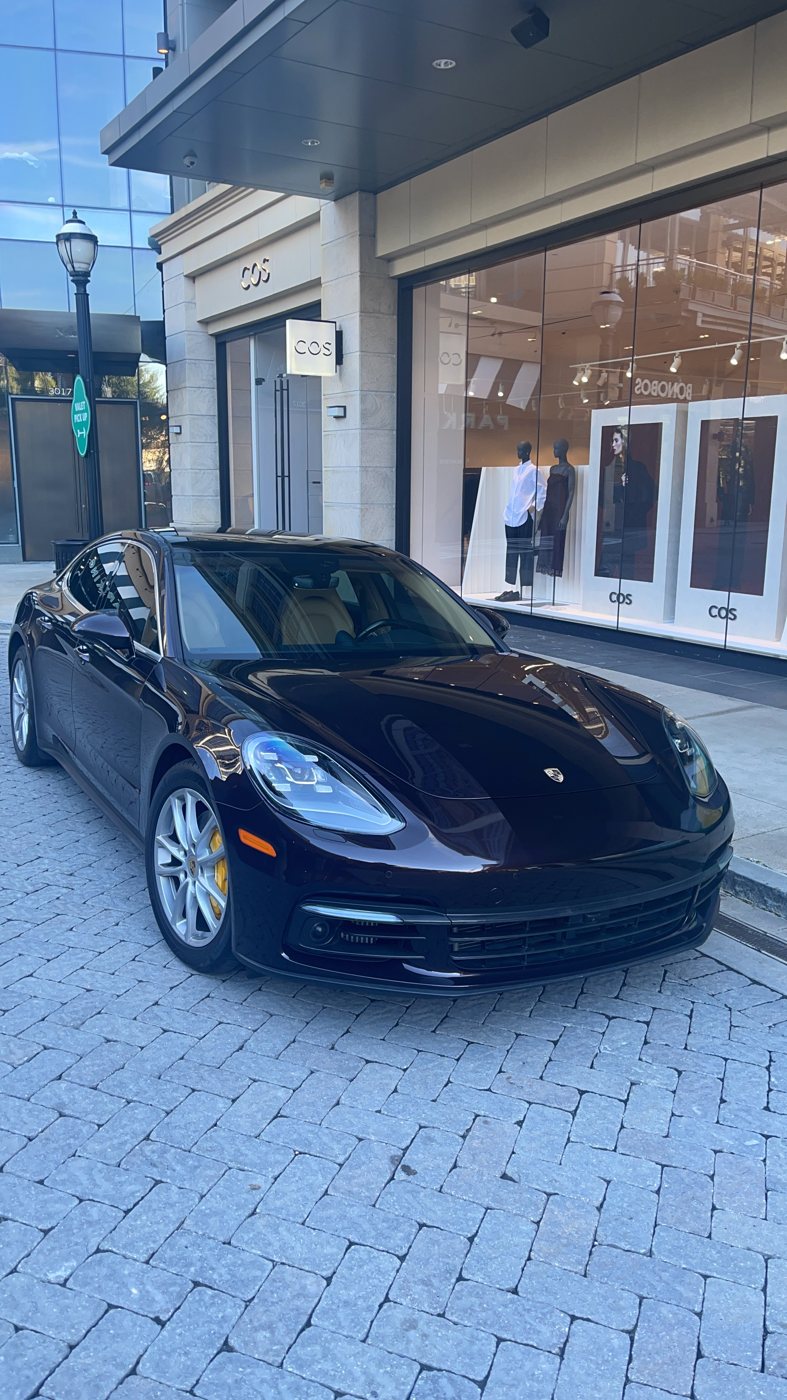
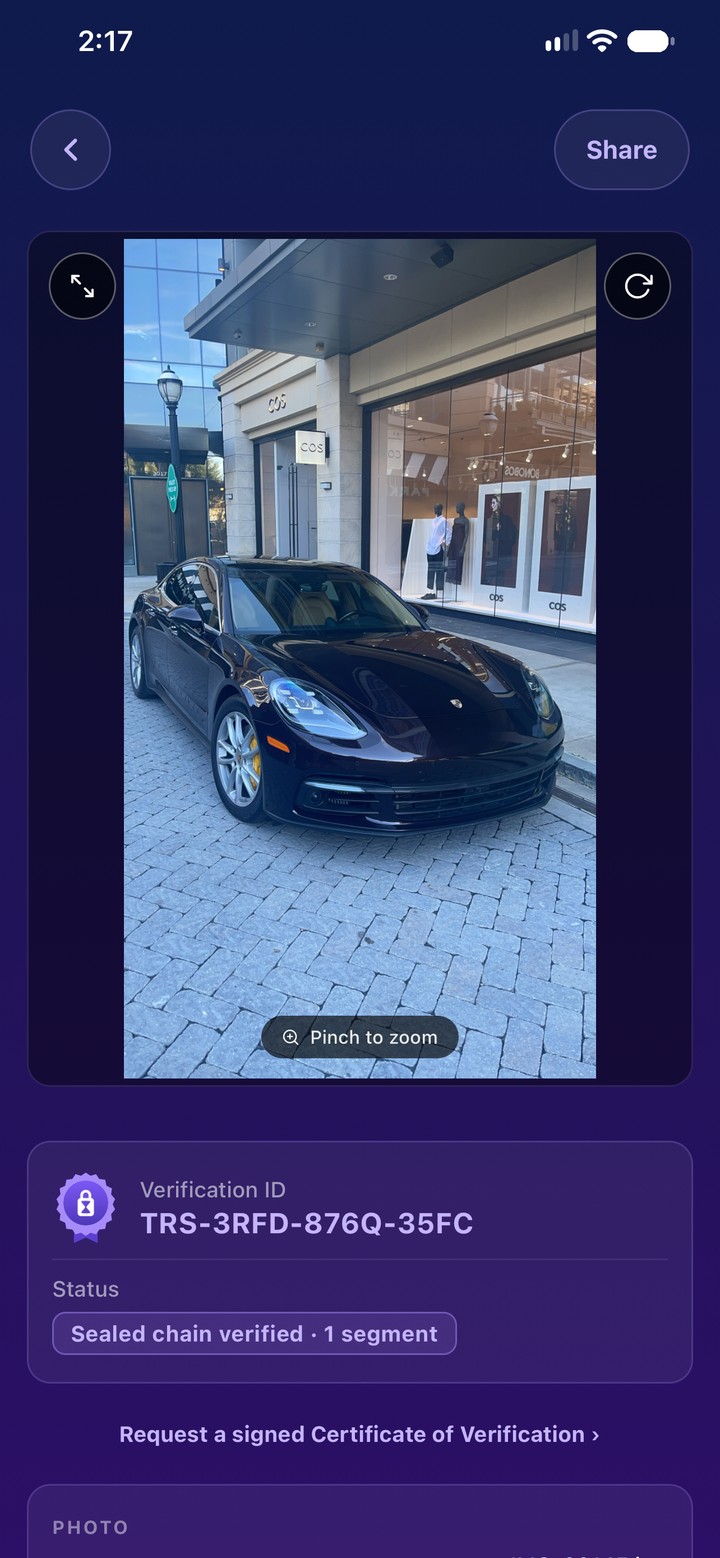
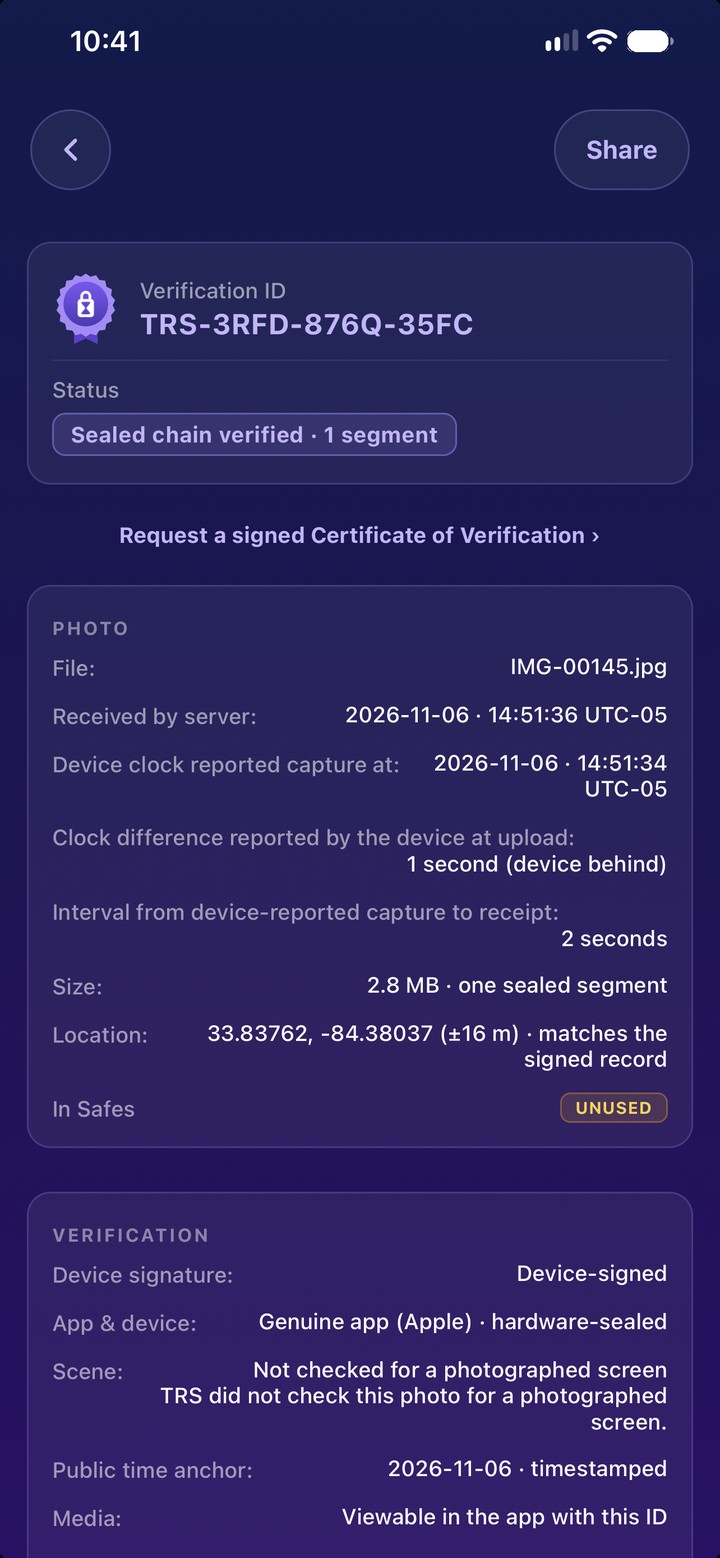
The second is the Macadamia Metallic Porsche parked in Buckhead Village in Atlanta, Georgia, taken on November 6, 2026. I will always be able to prove it’s real — that the moment happened. I took it with Time Release Safes (TRS). Its Verification ID is TRS-3RFD-876Q-35FC, and I’ve made it public, so you can check it yourself: open verify.timereleasesafes.com/TRS-3RFD-876Q-35FC in any browser, or enter the ID in your TRS app (menu → Verify a recording) to see the photo itself, along with everything that proves the moment and the pixels: captured, encrypted, sealed, verified — and unchanged since.
Here’s the part that surprises people: both photos were taken on the same phone, my iPhone 12 Pro Max — a 2020 model. Same camera, same lens. The only difference is that one was taken with the TRS app.
Today TRS launches its Verification and Certificate of Verification feature — built on a patent-pending architecture, and part of its portfolio of U.S. patent applications on file — because that gap, between what happened and what you can prove happened, is the most important problem in evidence today. It has a name.
The liar’s dividend
In 2019, law professors Danielle Keats Citron and Bobby Chesney named it the liar’s dividend. As fakes get better, the people who benefit aren’t only the ones who make them. They’re the people caught on real recordings, who can now say “that’s a deepfake” and be believed.
It’s already happening. Defendants have tried it against video evidence in courtrooms in Washington, D.C., Pennsylvania and California. Those attempts failed — this time. But every year the fakes get better, the claim gets more believable, and the burden quietly shifts onto the person telling the truth.
The companies building the generators aren’t promising a fix. In October, OpenAI policy counsel Shira Anderson told the federal judiciary’s evidence-rules committee: “AI images are only getting better, and I do not think that there will be a scientific way going forward to detect them.” Meta’s Devin Norder told the same panel that media from the newest models are “indistinguishable by humans,” and cheap and quick to make.
And the person telling the truth is usually a woman documenting abuse at home, a worker filming an unsafe site, a bystander recording a confrontation: someone with a phone, a real moment, and no money for an expert.
Why no lab can settle the Ferrari photo
Suppose someone says the Milan photo is fake, and I hire the best forensic examiner I can find. They’ll study compression, lighting, shadows, metadata, and the faint noise pattern every camera sensor leaves in its photos — the closest thing a camera has to a fingerprint. If they’re good and honest, the strongest thing they can tell a court is: we found no evidence it was manipulated.
That isn’t the same as it is real. Forensics looks for traces of tampering, and every trace is something a better generator can learn to leave out — or put in. Even the sensor fingerprint can be forged: researchers showed years ago that a camera’s pattern can be estimated from photos its owner posted online and stamped onto a fake, and a 2023 study showed a neural network can do it automatically, cutting forensic accuracy by about 75% in testing. The metadata that might help — date, place, camera — can be edited in seconds, and most of it is stripped the moment a photo is texted or posted.
“It’s over. Within a year or two, our whole visual system will be utterly useless.”
— Hany Farid, who helped found digital forensics more than 20 years ago, to The New York Times in June 2026, after failing his own deepfake testsAnd that inconclusive answer is expensive: $350–$550 an hour is the most common rate, and totals can reach tens of thousands of dollars — out of reach for most of the people who most need the truth believed.
What I can prove about the Porsche
The Porsche photo doesn’t wait to be questioned. Its proof was made the moment I pressed the shutter:
- Sealed as it was taken. Encrypted and sealed on my phone at capture, and signed by a key locked in the phone’s secure hardware.
- Genuine app, real phone. Apple confirmed it came from the genuine TRS app on real Apple hardware — not an emulator, not a modified app.
- Off the phone immediately. It reached our servers the moment it was taken. If my phone had been grabbed a second later, the record would already exist — and could be recovered on a different device immediately.
- Unaltered since. Its fingerprint was checked on arrival. Change a single pixel and the seal no longer matches — the verification is void.
- Time someone else vouches for. Every day our records are time-stamped by an independent authority — so the date doesn’t rest on my word, or ours.
- A record that can’t be stripped. The proof doesn’t live inside the image file, where sharing would strip it. It lives in a public record under its Verification ID.
You don’t have to trust me. Check the record at the link above, in any browser. To see the photo and the free verification information, enter the ID in the TRS app (Menu → Verify a recording) — it’s decrypted on your phone; our servers never decrypt it. And we publish the key that signs every record, so anyone can check our signature independently. We never make a capture’s location public — in fact, we can’t see it unless you choose to share it — and making the content public doesn’t mean the location rides along automatically. By default the public record says nothing about location at all — not even that one was recorded — because “withheld” is itself a disclosure. You choose. Your privacy is always the floor.
The proof travels with it. Evidence is only as good as its chain of custody. Inside TRS a capture is never copied: when I send the Porsche photo to someone, they receive the same sealed original with the same ID. If they save it to their own TRS Vault, they hold it under their own key, and it stays verifiable even if I later delete mine. If a court needs it on paper, a Records Custodian can issue a signed Certificate of Verification for $25.
What TRS does not claim matters just as much. It proves when and how a photo or recording was captured — never what it shows. A sealed photo or recording of a staged scene is still a staged scene. That honesty is what makes the rest believable.
How it compares
On the question that matters, TRS is ahead of the industry — and of the industry’s standards. In September 2026 Apple introduced Reference Image on the iPhone 18 Pro; the industry’s C2PA “Content Credentials” standard now ships on several cameras and phones, including Google’s Pixel 10; and Google’s SynthID watermarks media made by its own AI. All of it is real progress, and all of it answers a narrower question: is this file intact? TRS answers the question the liar’s dividend actually asks: did this moment happen, did the proof survive, and did it reach someone? Proof made at the moment of capture, evidence off the phone while it’s still recording, time vouched for by an independent authority, chain of custody that travels with the recording, a signed certificate a court can hold — point by point, these are places the current standards don’t yet reach. The chart below puts all five approaches side by side. And for most people, the real-world alternative is none of these systems — it’s hiring a forensic lab after the fact.
The current landscape — 11 claims, side by side
| System | Proof at capture | Video | Survives the phone | Survives sharing | Chain of custody | Independent time | E2E encrypted | Anyone can verify | Court-ready | No new phone | Free tier |
|---|---|---|---|---|---|---|---|---|---|---|---|
| Time Release Safes | ✓ | ✓ | ✓ | ✓ | ✓ | ✓ | ✓ | ✓ | ✓ | ✓ | ✓ |
| Apple Reference Image | ✓ | ✗ | ✗ | ✗ | ✗ | ✗ | ~ | ✗ | ✗ | ✗ | ✗ |
| C2PA Content Credentials | ✓ | ~ | ✗ | ✗ | ✗ | ~ | ✗ | ✓ | ✗ | ~ | ~ |
| Google (Pixel 10 / SynthID) | ✓ | ✗ | ✗ | ✗ | ✗ | ~ | ✗ | ✓ | ✗ | ✗ | ✗ |
| Forensic lab | ✗ | ✓ | ✗ | ~ | ~ | ✗ | ✗ | ✗ | ✓ | ✓ | ✗ |
✓ yes · ~ partial · ✗ no · every mark traces to the Sources below.
› See the full 13-point comparison
13 comparison points, in detail
| System | What it proves | Media covered | Where the proof lives | If the phone is taken or destroyed | Whose clock | Chain of custody | Who can verify | Legal output | Device coverage | Privacy | Staged-scene signals | Safety features | Cost to the user |
|---|---|---|---|---|---|---|---|---|---|---|---|---|---|
| Time Release Safes | A moment was captured, sealed, received and delivered: when, how, on what device | Video, audio and photos | A permanent record off the file: a Verification ID and public page | Already off the phone: video streams in real time, photos upload the moment they’re taken | Server receipt, device clock, and a daily anchor timestamped by an independent authority | A capture is never copied: the same sealed original, same ID; a recipient can hold it under their own key | Anyone with the ID, in any browser; the recording itself is viewed in the app, decrypted on the device | Signed Certificate of Verification from a Records Custodian — $25 | Any recent iPhone or Android, attested by Apple and Google | Content end-to-end encrypted; location private unless the owner discloses it | Screen-or-reflective-surface advisory and simulated-location flag — reported, never accusatory | Panic, live location, trust-circle delivery, Stealth Mode | Free on the phone you already own; paid storage plans; $25 per certificate |
| Apple Reference Image | A photo’s pixels came from this iPhone’s sensor | Photos only (main camera, 1× and 2×) | A “digital negative” stored beside the photo, on the phone | The proof is on the phone | Apple’s own signed timestamp service | Not addressed | Apple devices; third-party apps via Apple APIs | None announced | iPhone 18 Pro / Pro Max only | Anonymous to outsiders; Apple keeps a private log of photo and sensor IDs | Neural “looks like raw sensor data” score | None | Buy an iPhone 18 Pro; verification free |
| C2PA Content Credentials | A file’s history of edits | Mostly photos on phones | Metadata inside the file — removable by ordinary sharing | The proof is in the file on the phone | Optional; depends on the tool | Tracks edits, not who held the file | Any C2PA viewer | None | Select cameras and phones | Can reveal identity and tools | None | None | Free in supported cameras; editing chains often need paid software |
| Google (Pixel 10 / SynthID) | Pixel 10 photos carry C2PA Content Credentials; SynthID watermarks media made by Google’s own AI | Photos on the Pixel 10 camera (C2PA); SynthID covers Google-generated images, audio and video | Metadata inside the file (C2PA) — removable by ordinary sharing; an invisible watermark inside Google-made AI media | The proof is in the file on the phone | The device’s clock; C2PA timestamps optional | Tracks edits, not who held the file | Any C2PA viewer; SynthID detection for Google-made media | None | Pixel 10 (camera credentials); SynthID only on Google’s own AI services | Can reveal identity and tools (C2PA) | None at capture — SynthID labels Google-AI output, not re-filmed scenes | None | Buy a Pixel 10; free to use |
| Forensic lab | An expert opinion — at best, “no sign of tampering was found” | Any file presented to the examiner | The expert’s report, written after the fact | Often cannot establish much | Inferred from metadata, which can be stripped or altered | Examines whatever file someone presents; custody must be proven separately | The parties who can afford an expert; a court weighs the testimony | Expert report and testimony | Any device — after the fact | The examiner sees everything | Expert judgment | None | $350–$550 an hour; totals can reach tens of thousands of dollars |
Beyond the chart, three things set TRS apart: it covers video, sealed piece by piece as it records; it’s deep — one TRS record rests on 43 checks, carried by 13 design properties that keep working with no signal, a killed app, or a taken phone; and it’s within reach, on the iPhone or Android you already own, free to capture.
Where we’re not ahead — and how we defend the same ground. Apple signs photos at the camera sensor itself. That is the strongest single defense against a fully hacked phone, and credit where due. TRS seals in the app, so we defend in layers instead — and each layer is checked by someone who isn’t us. Before a capture is accepted, the phone must prove to Apple or Google that it is real hardware running the genuine, unmodified TRS app; the proof is signed by a key locked in the phone’s secure chip, which even a hacked operating system cannot pull out, and our servers verify it against Apple’s and Google’s own roots on a fresh challenge. Time is checked from four directions — the phone’s clock at the start, its clock at upload, our server’s receipt of every segment, and an independent daily timestamp from DigiCert — with every difference printed on the record, so a clock wound back to fake a date shows rather than hides. And the finished record is signed twice more: by the phone’s hardware key over the final manifest, then by our key, whose public half we publish. A hacked phone doesn’t have to beat one check; it has to beat all of them, live, during the capture — and anything it can’t beat is printed on the record as not established, never papered over.
Not just for emergencies
The liar’s dividend doesn’t only show up in courtrooms. It shows up anywhere someone can shrug and say “that’s fake.” So the best time to use TRS is before you know you’ll need it. Now. Start capturing all your moments — the good ones, the precious ones, and the bad ones — with TRS.
- The journalist. A reporter at a protest, a flood or a crash often has nothing but a phone. Canon now builds Content Credentials into its professional cameras for newsrooms — real progress, for the photographers who carry them. TRS brings sealed, independently timed capture to the phone in every reporter’s pocket, and the footage is off the phone before anyone can seize it. An editor can check the record before the story runs, and readers can check it after.
- The accident. A fender-bender, a fall on a wet floor, a tree through the roof. The scene changes in minutes; the stories change in days. A sealed TRS photo or video ends the argument — with the other driver, the property owner or the insurer — before it starts.
- The car you hand over. The rental at pickup, your car at the valet stand, the bumper before the body shop starts work. Thirty seconds of sealed video or photos settles “that scratch was already there,” whichever way the truth runs.
- The watch you’re about to drive across town for. Buying a high-end watch or a designer bag from a private seller usually starts with photos — and photos are the easiest part to fake. Listing shots get lifted from someone else’s sale, and even the “certificate of authenticity” can be counterfeit: police in British Columbia warned about a fake Rolex sold on Craigslist with forged papers to match. Before you get in the car with cash, ask the seller to shoot the item in TRS — the serial, the clasp, the dial up close — and send you the capture. Now you have sealed, just-taken footage proving the seller actually holds this exact item today, not a recycled photo — and a record you can show an authenticator before you ever meet. TRS won’t tell a real Rolex from a good fake; an expert does that. What it ends is the recycled-photo game.
- The bruise. An injury fades in a week; a dispute about it can last years. A photo sealed the day it happened can’t be waved away as edited or taken later.
- The date you haven’t met yet. Romance scams run on borrowed faces: a profile built from stolen photos, and a story that keeps its owner permanently out of reach — deployed overseas, working an oil rig, camera always broken. The FTC counted nearly 70,000 reports and $1.3 billion in losses in a single year, with a median hit of $4,400. Stolen photos are old by definition — so ask for a new one. Someone real can send you a TRS capture in thirty seconds: a quick video, sealed the moment it’s shot on a real phone, with an independent timestamp — holding up three fingers, or today’s coffee cup, whatever you asked for. A scammer running someone else’s pictures has nothing to send. It doesn’t prove a real person is a good person — the oldest rule still applies, and nobody you’ve never met needs your money — but it retires the borrowed face.
- The ten-year-old photo. Your daughter, grown, looks at a picture of the two of you at the beach and asks if it’s real — because by then, anything can be generated. You don’t have to say “trust me.” She can check it herself.
- The shot nobody will believe. The first time you nail a handplant on the half-pipe, and none of your friends believe it. The game-winner at the buzzer from half court. Film it in TRS, and the next time someone says “no way, that’s AI,” you send them the ID.
Everyday use matters for another reason, too. For someone in an abusive or coercive relationship, a safety app found on their phone can make things worse. A camera app people use for everyday photos draws no attention. The more of us use TRS for ordinary moments, the safer it is for the people who need it most.
The point isn’t to live in fear of fakes. It’s that the moments you care about most deserve proof that will outlast every new generator.
Protecting the real
Most of the deepfake conversation is about catching what’s fake. The liar’s dividend is a different problem: the cost of not being able to prove what’s real. Detection can only say “we found nothing wrong.” Proof made at capture can say “this happened, here is when, and here is how you can check it yourself.”
I’ll always remember Milan. But I can’t prove it, and in a world where anything can be generated, a memory is all that photo will ever be. The Porsche is different. Anyone, anywhere, can check it — today, next year, or in a courtroom ten years from now.
That’s why we built Time Release Safes: so the truth doesn’t depend on who can afford an expert. A credential proves a file is intact. TRS proves a moment happened, survived, and reached someone.
See the captures themselves — and all the information that rides with every video or photo — enter either ID in the TRS app (Menu → Verify a recording).
- Porsche photo: verify.timereleasesafes.com/TRS-3RFD-876Q-35FC
- Porsche video: verify.timereleasesafes.com/TRS-NG1M-YWBN-63WY
Get the app — free: App Store (iPhone) · Google Play (Android)
Sources
- Danielle Keats Citron and Robert Chesney, “Deep Fakes: A Looming Challenge for Privacy, Democracy, and National Security,” California Law Review (2019) — origin of “the liar’s dividend.”
- Tech Policy Press — deepfake claims against real evidence in U.S. courtrooms.
- Reuters, “OpenAI, Meta caution US judiciary about risk of deepfake evidence” (Oct. 15, 2026) — the Anderson and Norder statements to the Advisory Committee on Evidence Rules, Boston.
- Eli Saslow, “The World’s Leading Deepfake Expert No Longer Trusts His Own Eyes,” The New York Times (June 14, 2026) — the Hany Farid quote.
- Quiring et al., “On the Security and Applicability of Fragile Camera Fingerprints” (2019) — the fingerprint-copy attack on camera sensor patterns.
- Elliethy, “Neural noiseprint transfer,” PeerJ Computer Science (2023) — automated camera-noise transfer; ~75% drop in forensic accuracy on the DSO-1 test set.
- ComplexDiscovery Winter 2026 pricing survey and Law360 — forensic examination costs.
- MacRumors and The Next Web — Apple Reference Image.
- SoftwareSeni and DEV — C2PA Content Credentials.
- Google — Pixel 10 camera Content Credentials (C2PA) and SynthID watermarking of Google-AI media, per C2PA Viewer coverage and Google DeepMind’s SynthID documentation.
- FTC Data Spotlight (Feb. 2023) — romance scams: ~70,000 reports, $1.3 billion in reported losses, $4,400 median loss (2022 data).
- CTV News — Burnaby RCMP warning: fake Rolex with a counterfeit certificate of authenticity sold through Craigslist.
- Canon — Authenticity Imaging System for news organizations (May 2026).